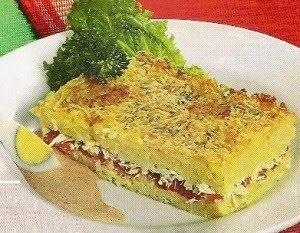
Este pastel es el típico acompañante del picante mixto aiquileño (provincia del departamento de Cochabamba); se suele servir también como un segundo liviano.
Para prepararlo necesitamos:
- tazas arroz
- 1/2 cucharilla sal
- tazas agua
- 1 cucharilla orégano
- 2 cucharillas sal
- cucharas ají amarillo,
- cucharas aceite molido y frito
- 2 cebollas
- 1/2 taza agua ó caldo
- 1 tomate mediano
- huevos
- 1 cuchara perejil, picado
- 1 taza leche
- 1/2 cucharilla pimienta
- 2 quesillos grandes dulce
Lavamos el arroz y lo ponemos al agua hirviendo con la sal; lo dejamos a fuego regular por ocho minutos y luego a fuego suave hasta que reviente el arroz. Colocamos a una bandeja y dejamos enfriar.
Mientras tanto sofreímos en el aceite caliente la cebolla finamente picada; al cabo de cinco minutos añadimos el tomate picado, hierbas, condimentos y el ají, mezclando de rato en rato con una cuchara de palo. Al final agregamos el agua y dejamos que se impregne con el sabor del ají.
Aparte hacemos cocer dos huevos duros y los otros tres los batimos ligeramente con la leche para mezclarlo al arroz ya frío. A una fuente de horno ó pirex (ligeramente untada con manteca) colocamos la mitad del arroz, encima el quesillo en rodajas y un huevo duro también en rodajas; rociamos con el ahogado y cubrimos con la otra mitad del arroz para volver a decorar con quesillo, huevo y el saldo del ahogado.
Ponemos a horno regular (180° C.) por media hora ó hasta que este dorado .
Cocina Tradicional Boliviana
Romero de Velasco, Emilia – Gutentag de Muzevich, Carola
Editorial Amigos del Libro, La Paz. Bolivia. 1988





Quiero darte las gracias de nuevo por haber pensado en mi para este premio. Los invito a visitar el blog de Marina, que estoy segura les gustara y sera de mucha utilidad para conservarse saludables.
https://consejonutricion.wordpress.com


Shapes, colours, numbers and sounds) have been applied to architecture, telecom networks industrial design, boats and aeroplanes to transmute the effects of environmental energy disturbances from sources such as electromagnetic radiation, structural design and cosmic and earth energy radiation. BG is also being applied to agriculture, poultry, fish, and livestock farming to increase productivity and quality leading to the reduction of controversial chemicals and artificial treatments.
thanks for sharing..welcome!
Check more : https://www.poetryfoundation.org/poems/52341/hamatreya
… liked this!
"One traditional analogy is dust on the mirror, which interferes with the divine expression of our true nature. But we can increase the transparency of that reflection, a very gradual process but can fluctuate, given our inconsistent behavior and insights.
We do not need to generate our own luminosity, but merely reflect the universal radiation that falls on each of us. We can strive for understanding. We can become a clear mirror to the light of the universe.
all experiments failed to reveal this suspected medium, and special and general relativity at last did away with the need for it entirely. Can we point to any evidence at all in favor of the aether’s existence?
Image : The longer a photon’s wavelength is, the lower in energy it is. But all photons, regardless of wavelength/energy, move at the same speed: the speed of light..the speed of all forms of light is measured to always be the same for all observers.
Primordial god embodying pure light and upper air beyond the mortal sky.
Often born from Chaos; sometimes from Night (Nyx) and Darkness (Erebus). Sibling to Hemera (Day), bringing light after darkness in creation myths.
Medium where gods breathe and stars move — untouched by decay or storms.
Inspired philosophers to describe a perfect “fifth element” above the four basics.Legacy lived on in Renaissance cosmology and the later scientific “luminiferous aether.”
… liked this!
uuuh tiene una pinta deliciosa y golosa! en mi hogar gusta mucho el dulce de leche, seguro que les encanta, gracias!
… liked this!
Muy buen post! Me encanta siempre lo que subes. Un abrazo grande desde mi buenos aires querido!
Maravilloso! Me ha encantado tu post y por cierto, buen blog. Un abrazo fuerte desde argentina!
Cristina Gracias x responderle a Facundo la intención es apreciable ... En realidad en Aiquile se prepara la "leche de coco" es de origen vegetal, del coco, un tipo de palma que producen en Chuquisaca, en Tarabuco... Decía la leche de coco se prepara moliendo el coco en batan de piedra, hasta obtener una masa pastos y de allí obtener su "leche" (jugo del coco) y luego se hace hervir con canela y clavo de olor en agua. Se sirve caliente con pastel de queso. No contiene nada de origen animal y tampoco alcohol.
Si puedes darte una escapada por los valles tanto del sur de Cochabamba, norte de Chuquisaca y norte de Potosí encontraras exquisiteces muy peculiares y propias a ser descubiertas y degustadas que también aportan al patrimonio de la cocina boliviana.
Muchas gracias por tan valioso blog y aporte al mundo Cristina.
PD: Sabes donde se puede encontrar regaliz en Cochabamba?
Que hermoso blog!!! Gracias por todo la compilación y tu tiempo.🤗🤗🤗🤗
Estupendo trabajo!